
Best Swim Fins for Training: The Right Pair for Every Swimmer (NZ Guide)
Most people try fins for the first time and think two things.
First: this feels like cheating.
Second: why wasn’t I doing this the whole time?
Fins are one of the most useful tools in the pool. They fix your body position, build your kick, and give your shoulders a break on big training days. They also make you faster, which is great for morale.
But fins aren’t one-size-fits-all. A pair built for a beginner working on technique is a very different thing from a pair built for a squad swimmer chasing a time. Pick the wrong ones and your ankles will let you know about it.
So we’ve matched five types of swimmer to the fins that suit them, with NZ prices and where to buy each pair. We’ve also put together a buyer’s guide to help you work out what you need before you spend a cent.
Why Fins Make You a Better Swimmer
Before we get to the picks, it helps to know what fins actually do. “They make you go faster” is only part of the story.
They fix your body position
Fins lift your legs and keep your hips high, which is where they should be.
If you’re a swimmer whose hips sink, a few laps in fins will show you what good body position feels like. It’s the quickest way to feel it, and once you’ve felt it, you can start chasing it without the fins.
They loosen up your ankles
An efficient freestyle kick starts with a relaxed, floppy ankle. Most of us have ankles that are stiffer than we’d like to admit, especially if we spend our days at a desk.
Regular time in fins stretches them out gradually. That flexibility carries over into your kick when the fins come off.
They build leg strength
Fins add resistance, and resistance means your legs work harder. Do that a few times a week and your kick gets stronger.
Your legs probably wouldn’t volunteer for this, but they’ll thank you in a few months.
They take pressure off your shoulders
If you’ve got a niggly shoulder or you’re in the middle of a big training block, fins let you keep moving through a set with less load on your upper body.
You still work hard. Your shoulders just get a breather.
They teach your legs what a good kick feels like
Fins let you feel the right movement at speed. Your legs learn the pattern, and that pattern follows you when the fins go back in the bag.
That’s why fins are as useful for technique work as they are for fitness sets.
How We Choose: What Makes a Good Training Fin
“Best” depends on who’s wearing them. Here’s what we looked at for each type of swimmer.
Beginners and technique swimmers
Comfort and feel matter most. You want fins that lift your hips and slow your kick down to a pace you can work with, without rubbing your feet raw. A closed heel and a flexible blade keep things simple.
Squad and club swimmers
You’ve got a solid kick already, so you want fins that make your legs work. Durability matters too, because squad sessions are not gentle on gear.
Competitive swimmers
Fit, responsiveness and a blade built for fast kicking. This is a specific use case, and it’s worth paying a bit more for fins designed around it.
Open water and ocean swimmers
Fins that cope with the sea, not just the pool. Something that handles chop, sand and the walk back up the beach.
Kids and junior swimmers
Fit is everything. A fin that’s too big slips off, and a kid who has to fight their fins will quickly stop wearing them.
The Best Swim Fins for Training at a Glance
|
Swimmer type |
Best pick |
Price (NZD) |
|
Beginners and technique swimmers |
From $55.99 |
|
|
Squad and club swimmers |
From $65.99 |
|
|
Competitive swimmers |
$99.99 |
|
|
Open water and ocean swimmers |
$75.00 |
|
|
Kids and junior swimmers |
From $46.99 |
The Best Swim Fins for Every Type of Swimmer
Beginners and Technique Swimmers
Our pick: Aqualine Adults Long Blade Training Fins (from $55.99)
The best swim fins for beginners and technique swimmers are the Aqualine Adults Long Blade Training Fins, which lift your hips, slow your kick down to a pace you can work with, and give you a comfortable, secure fit while you learn.

If you’re new to training with fins, start with a long blade.
The bigger blade gives you more propulsion. That means less effort spent keeping your legs up and more attention for what your arms and breathing are doing.
It also slows your kick down. That sounds backwards, but a slower, more deliberate kick is closer to what efficient freestyle looks like. You’re not thrashing. You’re working with the water.
These are made from natural rubber with a closed heel, so your foot sits snug and secure. The rubber is flexible and feels like an extension of your foot rather than a plank strapped to it. That matters when your ankles aren’t used to the range of motion yet.
They also come with a mesh carry bag, which means your fins won’t escape into the bottom of your gym bag.
One thing to know: sizing runs on the small side. If you’re between sizes, go up. Aqualine also has a fit guarantee, so if they don’t fit you can get a refund.
Prices are sized, from $55.99 at the smaller end, so check your size before you decide. They’re also the most affordable fin in this guide.
Squad and Club Swimmers
Our pick: Aqualine Adult Short Blade Training Fins (from $65.99)
The best swim fins for squad and club swimmers are the Aqualine Adult Short Blade Training Fins, made from 100% silicone with a stiffer short blade that makes your legs do the work and keeps your kick close to its natural tempo.

If you’ve been training for a while, a long blade starts to feel like it’s doing the job for you.
A short blade has a smaller surface area, so your legs have to do more. That’s the point. You build stronger, more active kick strength, and your kick rhythm stays close to what you use without fins.
The silicone construction comes with a soft heel and foot pocket designed to cut down on friction, which helps over a long session. They’re also compact, so they slot into a squad bag without taking over the whole thing.
Sizes run from 37/38 to 45/46, and the price goes up with size, starting from $65.99.
They’re built for kick sets, body position work and drills. In other words, exactly what your coach is about to write on the whiteboard.
Competitive Swimmers
Our pick: Arena Powerfin Pro II ($99.99)
The best swim fins for competitive swimmers are the Arena Powerfin Pro II, a short blade silicone fin designed for power training and a faster kick.
This is a different tool from a general squad fin, and it’s priced like one.
The Powerfin Pro II is made from soft, PVC-free silicone with an open heel for ankle flexibility. The left and right fins are individually shaped, there are side grooves for better control, and notches on the bottom ribs are designed to help you kick faster.
Arena makes these for competitive swimmers, and it shows. They’re responsive and built for people who care about the details of their kick.
They cost around $34 more than Aqualine’s short blade starting price. If you’re racing regularly and want a fin built around that, it’s money well spent. If you’re a fitness swimmer who trains with a squad, Aqualine’s short blade will do the job for less.
Sizes follow the French/international system (36-37 up to 46-47), so check Arena’s size chart before ordering.
Open Water and Ocean Swimmers
Our pick: Speedo x DMC Super Fin ($75.00)
The best swim fins for open water and ocean swimmers in New Zealand are the Speedo x DMC Super Fin, a soft silicone fin designed for fitness swimming and bodysurfing that handles the transition from pool to beach.
The sea is a different kind of workout.
There are no lane ropes, and the swell has opinions about your pace. After a swim you also have to get yourself and your gear up a sandy beach.
The Super Fin is built for exactly that. It’s made from DMC’s softer SILFORM silicone for comfort, with a universal foot cavity and a centre drain chute so water clears quickly between the pool, the deck, and the sea. A patented Reverse V Rail helps stabilise ankle roll, so your kick stays on track.
It’s aimed at fitness swimmers of all levels, so it suits anyone who wants fins that can handle both the pool and the ocean.
If you want a dedicated ocean fin, the Speedo x DMC Repellor X is built for bodysurfers and open water athletes.
If most of your swimming is in the pool and the ocean is a bonus, Aqualine’s long blade is a good choice for building the leg endurance open water asks for.
Kids and Junior Swimmers
Our pick: Aqualine Kids Long Blade Training Fins (from $46.99)
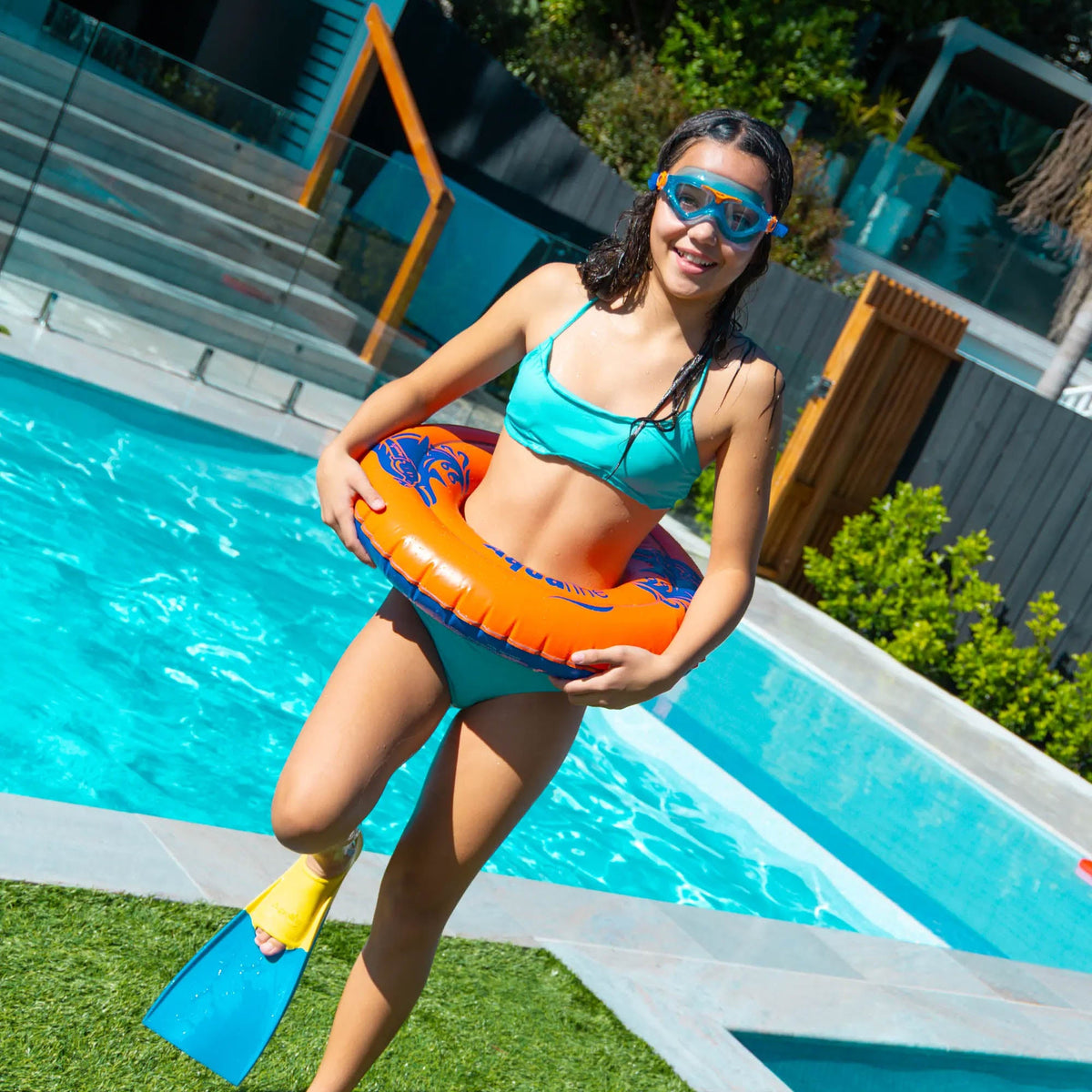
The best swim fins for kids and junior swimmers are the Aqualine Kids Long Blade Training Fins, sized for smaller feet and designed to help young swimmers feel their body position and build kick confidence.

Fins for kids have one non-negotiable rule: they have to fit.
An adult fin on a small foot slips, sits at the wrong angle and turns a good session into a battle. Junior fins are cut for smaller feet, and you can tell the difference straight away.
A long blade is also the better starting point for most kids. It gives them the propulsion boost they need to feel body position and gain confidence, without the extra effort a short blade demands.
If you want to compare, the Arena Kids’ Junior Swim Fin is $44.99. It’s made from soft, PVC-free thermoplastic elastomer with an open heel, and it comes in five sizes from 26-27 to 34-35.
Whichever you go for, check the size chart before you order. Kids’ feet grow, and fins that fit now might not fit next season.
What to Know Before You Buy
Long blade vs. short blade
This is the question most people have, and the one most guides skip past.
|
Long blade |
Short blade |
|
|
Propulsion |
More |
Less, so your legs do more work |
|
Kick tempo |
Slower |
Closer to natural pace |
|
Best for |
Beginners, technique drills, endurance |
Squad training, building kick strength |
|
Feels like |
A helping hand |
A workout |
|
Our pick |
Aqualine Adults Long Blade |
Aqualine Adult Short Blade |
A long blade has a bigger surface area, so it pushes more water. That lifts your hips, slows your kick down and makes it easier to focus on technique.
A short blade has a smaller surface area, so your legs carry more of the load. The kick feels more natural, and the strength you build transfers better when you take the fins off.
If you’re new to fins, start with long. If you’ve been using them for a while and want more of a challenge, move to short.
Open heel vs. closed heel
Closed heel fins cover the whole foot like a shoe. They stay put, feel secure and suit beginners well. Aqualine’s long blade fins are closed heel.
Open heel fins leave the back of the foot open. They give your ankle more room to flex and can be easier to get on and off. Arena’s Powerfin Pro II and Kids’ Junior fins are open heel.
If you’ve tried one style and found it uncomfortable, try the other.
Blade flex and material
Fins are usually made from rubber or silicone, and the material changes how they feel.
Natural rubber (like Aqualine’s long blade) is flexible and feels like a natural extension of the foot.
Silicone (like Aqualine’s short blade, the Powerfin Pro II and the Super Fin) is soft against the skin, and brands like Arena promote it for reducing blisters.
Stiffer blades give you more propulsion but ask more of your ankles. If you’re starting out, a more flexible fin is kinder to your feet.
Sizing and fit
Fit is where most people go wrong, and it’s worth getting right.
Sizing differs between brands. Aqualine’s long blade runs on the small side, so size up if you’re between sizes. Arena uses French/international sizing, so check their size chart rather than guessing from your shoe size.
A fin that’s slightly loose is annoying. A fin that’s too tight is how you end up with blisters.
For kids, buy for the foot they have now. Oversized fins that they’ll grow into are more likely to slip and put them off.
Which Fins Are Right for You?
Picking the right fins shouldn’t take longer than a warm-up.
If you’re new to fins, start with Aqualine’s Adults Long Blade Training Fins. They’re the easiest way to feel what good body position is like, and they cost less than anything else here.
If you’re already training with a squad and want more of a workout, the Aqualine Adult Short Blade Training Fins are the next step up.
If you’re racing and want a fin built for it, look at the Arena Powerfin Pro II. If your swimming happens in the ocean, the Speedo x DMC Super Fin is worth a look.
For the kids, the Aqualine Kids Long Blade fins are a good place to start.
Dry is Boring. Fins just make getting wet a bit more fun.